
Game Rules
Fast tactical Realm matches.
Mythrel is a turn-based trading card game for physical and digital play. Build a deck, manage Mana and Health, summon creatures, cast spells, equip cards, and use combat abilities to break the opponent board.
Download the official Mythrel rulebook PDF for a clean tabletop reference, tournament handout, or offline rules copy.
Introduction
Mythrel is a tactical two-player trading card game built for physical tables and digital Realm matches. Players use Mana and Life, summon creatures, cast spells, equip cards, and use combat abilities to break the opponent board.
The digital client enforces shuffling, drawing, turn timers, combat states, rewards, rankings, collections, and market ownership. Physical play follows the same rules with counters, dice, timers, or the Mythrel counter tool.
Objective
Win by reducing your opponent health to zero or by forcing them to run out of cards in their deck. Each player begins with 35 Health and 1 Mana.
In the rare event both players run out of cards or both reach 0 Health at the same time, the match is a draw.
Health and Mana
Health, also called Life, starts at 35. Mana starts at 1 and increases by 1 at the start of your turn up to a maximum of 10.
Mana is spent to play most cards from hand. Life Cost cards spend Health instead of Mana and cannot be played if the player does not have enough Health remaining.
Deck Construction
Decks contain a minimum of 25 cards and a maximum of 40 cards. Digital Realm modes enforce these limits automatically.
- Most cards allow up to 4 copies per deck.
- Mythical and Exotic cards allow 1 copy per deck.
- Life Cost cards allow 1 total copy per deck.
- Promotional cards allow 1 copy per deck.
- Elysia's Drake allows 2 copies per deck.
- Within Reason allows 2 copies per deck from any set.
Start of Match
Any fair random method may decide who starts first. Each player shuffles, then draws 5 cards.
The second player draws 1 additional card for a 6-card opening hand. Each player may choose one Mulligan before the match begins.
Mulligan and Hands
A Mulligan discards the opening hand and draws a fresh 5-card hand. Players can Mulligan once per match and have 30 seconds to decide in digital play.
There is no hand-size limit. Cards can be played during your turn if you can pay the required Mana Cost or Life Cost.
Turns
Digital turns last up to 60 seconds. At the start of your turn, you gain 1 Mana up to 10 and draw 1 card from your deck.
Each turn has a draw phase, a main phase for playing cards and attacking, and an end phase when the timer expires or the player ends turn.
Battlerealm and Graveyard
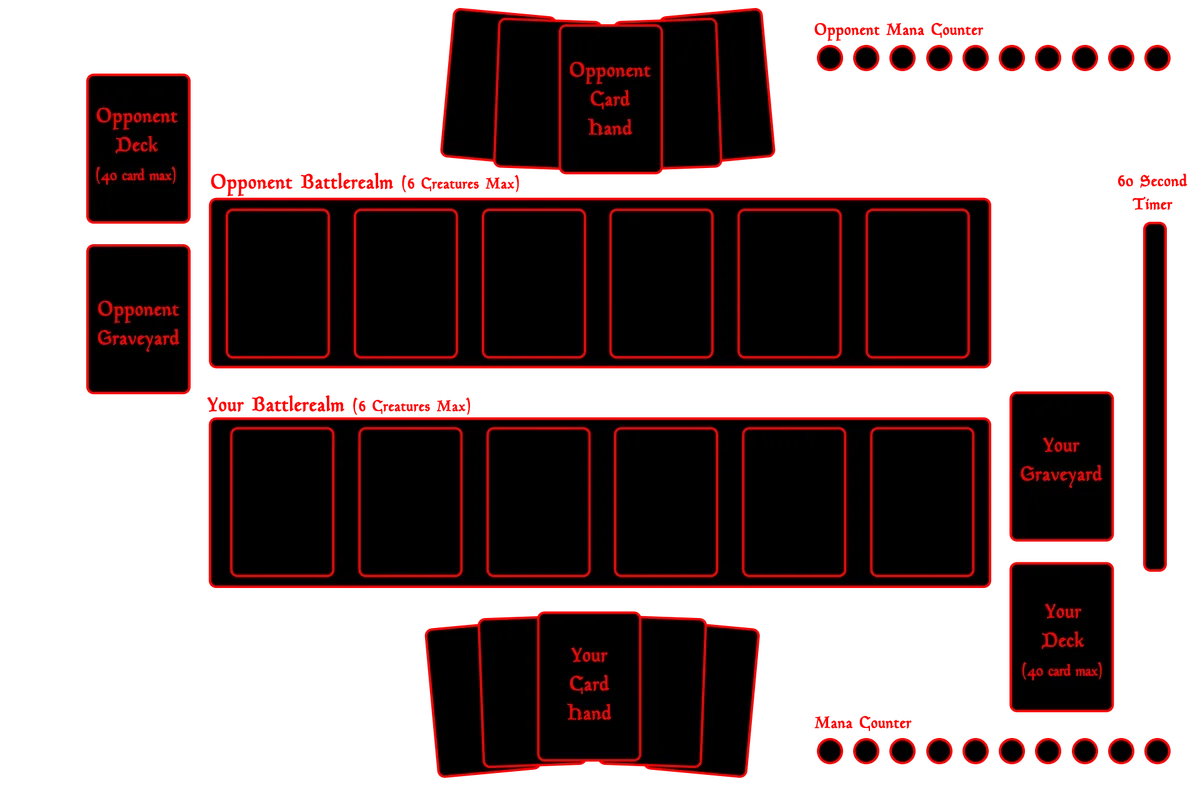
Creatures, spells, and equipment are played into the battlerealm. Each player can control up to 6 creatures at a time.
Destroyed creatures, discarded cards, and used spells or equipment go to the graveyard so both players can understand the match state.
Creatures
Creature cards can be played during your turn if you have enough Mana or Life to pay their cost.
Creatures are summoned into your battlerealm. Swift creatures can attack immediately; other newly summoned creatures are sleeping until your next turn.
Tournament and League Play
Players should bring a legal deck and a method of tracking Health, Mana, timers, and temporary statuses. Prototype and test-print cards are not legal in official tournament or League play.
Digital League play runs on weekly cycles with leaderboard rewards. Leaving a ranked digital Realm before it finishes can add a loss.
Conceding and Penalties
Conceding is a voluntary forfeit. In ranked digital modes, the conceding player receives a loss while the opponent still finishes the Realm state.
Cheating or breaking tournament rules can result in match penalties, disqualification, or digital account enforcement.
ELO
ELO ranks players in competitive Realm modes. Players start at 1200 ELO with a minimum ELO of 100.
Match results compare your rating against the opponent rating, then update based on win, draw, or loss outcome.
Combat Abilities
Readable board states, sharp tactical pressure.
These are the keywords most likely to change combat priority, damage prevention, sleep timing, or temporary creature statuses during a Realm match.
Opponent creatures must attack this before other targets.
A Blocker shields the player and other creatures until it is removed or loses the ability.Can attack immediately after being summoned.
Creatures without Swift enter play sleeping and wake on their controller next turn.Deflects the first combat damage event, then dissipates.
Spells ignore Ward and deal damage as normal unless the card text says otherwise.Gives Poison to creatures damaged in combat.
Poison deals 1 damage at the start of the affected creature controller turn.Gives Frozen to creatures damaged in combat.
Frozen creatures cannot attack during their controller next turn, then thaw.Applies Cracked before combat damage.
Cracked disables Ward and Blocker while active, opening the target to normal combat pressure.A guard-break status caused by Sunder and some effects.
Cracked does not deal damage by itself; repair and Cleanse effects can remove it.Cards and Costs
Creatures, spells, equipment, Mana, and Life all have distinct rules.

Spells
Spells can buff creatures, destroy enemy creatures, protect Health with Bulwark, Snare the next summon, Cleanse harmful states, or Seal abilities before cards reach the battlerealm.

Equipment
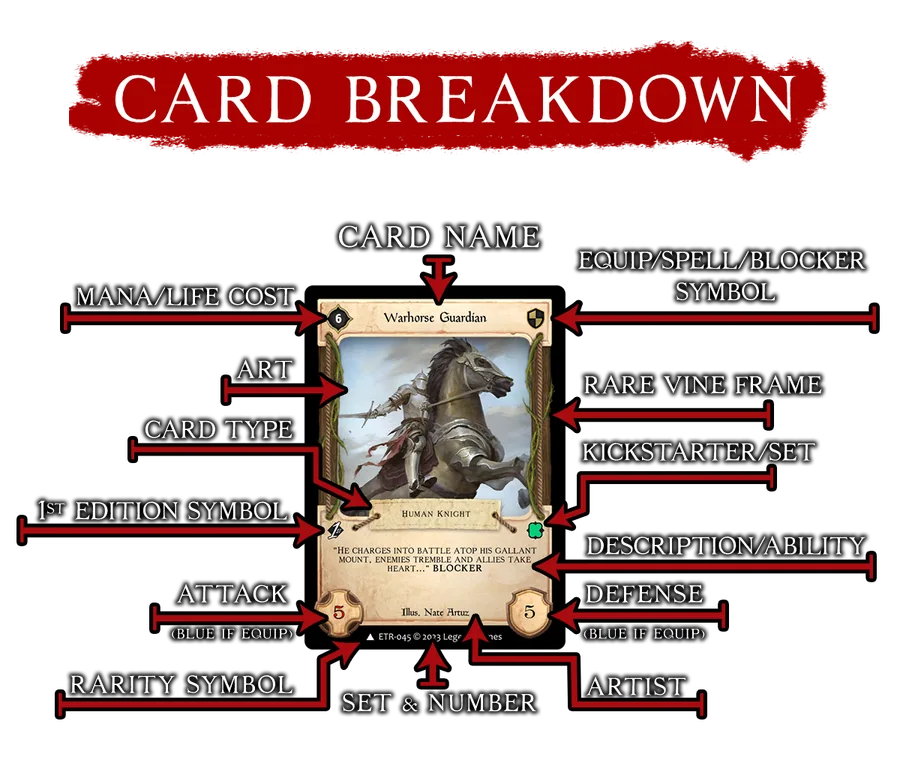
Equipment attaches to creatures in the battlerealm to grant attack, defense, or abilities such as Ward, Frost, or Sunder. Equipment uses the Eye of Protection symbol.

Mana Cost
Mana Cost cards show a white cost in the top-left corner and require that much Mana before they can be played.

Life Cost
Life Cost cards show a red cost in the top-left corner and require that much Health. Only one Life Cost card may be included in a deck.
Realm Layout
Creatures, graveyards, hands, and resources stay visible.
The digital client enforces turn timing, draw order, deck limits, combat targeting, health, mana, ownership, rewards, and market transfer rules. Physical play should follow the same rules and can use the counter tool for clean state tracking.
Collectible Card Rarities
Rarity symbols used across the card database.
 Common
 Uncommon
 Rare
Rare Mythical
 Exotic
 Promo
PromoRules FAQ
Quick answers for common gameplay questions.
What are the main combat abilities?
Blocker must be attacked first, Swift can attack immediately, Ward deflects first combat damage, Toxic applies Poison, Frost applies Frozen, and Sunder applies Cracked before damage.
How do status effects work?
Poison deals damage over time, Frozen stops the next attack, Cracked disables guard abilities, Snare freezes the next summon, Bulwark absorbs player damage, Seal removes listed abilities, and Cleanse removes harmful states.
Do physical and digital Mythrel use the same rules?
Yes. Physical play should follow the same rules while digital play enforces shuffling, drawing, resources, timers, combat states, rewards, rankings, and ownership.
Glossary
Key terms players will see in cards and Realm matches.
- Attack
- A creature dealing damage to an opponent creature or player.
- Ability
- A special card effect, often printed on a creature.
- Mana
- The resource used to play most cards.
- Life Cost
- A red cost paid with Health instead of Mana.
- Battlerealm
- The area where creatures, spells, and equipment are played.
- Blocker
- A creature ability that forces opponent creatures to attack it first.
- Poison
- A status that deals 1 damage at the start of the affected creature controller turn.
- Frozen
- A status that prevents a creature from attacking during its controller next turn.
- Cracked
- A status that disables Ward and Blocker while active.
- Bulwark
- A temporary player shield that absorbs incoming player damage.
- Snare
- A temporary status that freezes the next creature the affected player summons.
- Seal
- Removes a listed ability before a card reaches the battlerealm.
- Cleanse
- Removes harmful states such as Poison, Frozen, or Cracked from friendly cards.
- Origin Realms
- Ranked standard digital Realm play that contributes to account level.
- Vortex Realms
- Random-deck digital Realm play with separate Vortex ELO.
- Tranquil Realms
- Unranked digital Realm play without ranking penalties.
- Gauntlet
- Random-deck reward mode that can grant Dragon Scales.
- ELO
- The rating used to rank players in competitive Realm modes.
Rules last updated June 26, 2026.